What to include in a proxy support ticket
Write a proxy support ticket with an approved fixture, timestamps, sanitized diagnostics and a testable expected result.
Describe one reproducible failure
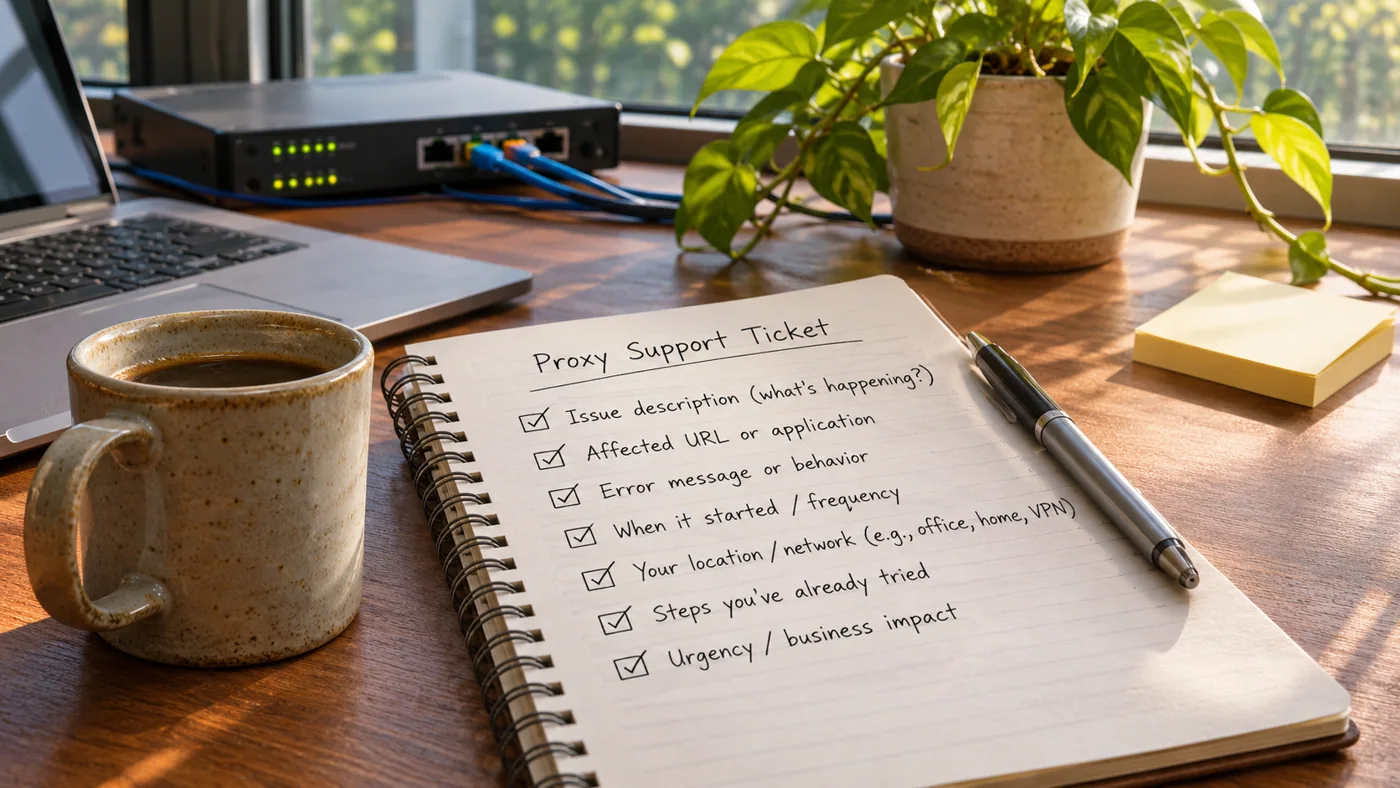
A support engineer can do more with a single well-described fixture than with a screenshot saying a service feels slow. Start with an approved test destination and a timestamp in UTC. State the expected outcome and what actually happened. Describe the client version, operating system, proxy product, requested region and whether the same fixture recently worked.
Locate the stage where the evidence changes
An authentication challenge from a gateway points to a different question than a valid connection followed by the wrong language at an owned storefront. Include the response status or a sanitized client message, any timing values worth comparing, and a request identifier from your own application. Capture a direct reference result if it is an authorized and meaningful comparison for the case.
Include the last known successful run for the same fixture if one exists. That gives support a bounded window in which to check deployment, account or routing changes without searching a full month of unrelated observations. OWASP logging guidance.
Make the ticket safe to share
Remove passwords, authorization headers, session cookies and personal customer details. Keep an internal reference to fuller diagnostics under your organization's access rules. In an XtremeProxy support request, include the allowed destination and whether delivery is blocked or only slower than usual. That distinction helps everyone prioritize the incident and gives the person following up a clear criterion for closing it.
A support ticket that reproduces an owned fixture failure
A QA runner receives an unexpected sign-in page when retrieving an owned report fixture. The ticket includes the assignment reference, test environment, UTC timestamp, client version, expected marker, observed status and a safe correlation ID. A second authorized client succeeds on the same fixture. That difference gives support a specific application configuration to inspect. Redact query secrets, authorization headers and personal records before attaching a minimal extract, and retain the unredacted original under your organization's normal controls.
Include a control result from the same interval
Support benefits from knowing whether another approved fixture or client worked at the time. Include the control's timestamp and application version. A redacted excerpt showing the stage and expected marker can be more useful than a large capture from a completely different environment.
Include the time zone and precision of each timestamp supplied to support. A local time copied without its offset can match the wrong event, particularly during a seasonal clock change. Send the smallest interval and safe request identifier that let the service owner find the corresponding trace.
Give support a timeline it can match
A fixture fails at 09:14 UTC and a control succeeds at 09:16 UTC. Include those instants with their environment and safe request references. A screenshot labeled this morning is ambiguous across time zones and support shifts. If the application was updated between the attempts, disclose that fact before using the second observation as a control.
Write the expected behavior as something the support engineer can recognize. “The network is slow” offers no threshold. “the owned staging fixture returned the expected 2 MB file after the job’s ten-second deadline” identifies both the outcome and the decision being made. Include the ordinary baseline for the same file and time window if available. This gives the engineer a way to confirm improvement after a change without requiring access to the customer’s original private payload.
Record the time of the most recent successful run under the same conditions, if one exists. A failure that starts immediately after a worker upgrade calls for a different first comparison from one that also affected the older build three days earlier. Include the version change and safe fixture reference without asserting that the upgrade caused the incident. The receiving engineer can use that timeline to choose a controlled comparison and return evidence that confirms or rules out the suspected change.
Related fieldwork
A support handoff should let another engineer recognize the same failure on the same approved fixture without ever seeing a customer's content or the credential. Regional API version rollout provides an example of a known regional service revision. Understanding HTTP 407 and 401 during a proxy integration narrows one common symptom to the party that actually issued the authentication challenge. Technical references include libcurl timing information. Review XtremeProxy plans and allowances.
Frequently asked questions
Does support need a full session capture for the first report?
Start with the smallest evidence that distinguishes the failing stage. If additional data is needed, agree on a protected channel and scope with the responsible team. Avoid sharing reusable secrets or unrelated customer activity.